
“The function of prayer is not to influence God, but rather to change the nature of the one who prays”
– Søren Kierkegaard
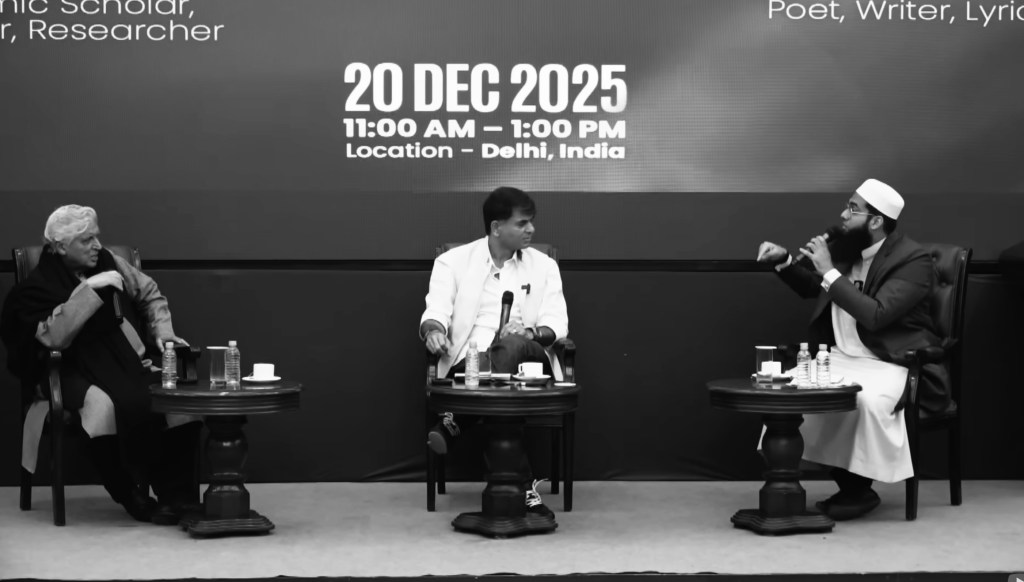
The following essay is a perspective on the recent debate between Javed Akhtar and Mufti Shamail Nadwi on The Lallantop youtube channel.
I preface this essay by saying that Mufti makes invalid arguments over the existence of God, and would’ve failed completely in front of a well-prepared, logically skilled academician. He constantly engages in cognitive leaps to justify his theistic viewpoint on the existence of God and hides behind jargon.
Javed Akhtar on the other hand, also does not do a very good job of defending his atheist viewpoints and falters in many places.
However, my essay is not focused on this, but on a different idea which I believe would be beneficial if considered in its entirety.
Strip away the labels of any extremist belief, observe the underlying patterns of the stories in their ideology, and you’ll come to find that even the most polar opposite ideologies end up implementing the same rulebook to assert themselves against an opposing ideology.
Javed Akhtar and Mufti Shamail Nadwi’s recent debate on the existence of God lays this clearly for us to see. Credit where it’s due, the debate is laudable for its civility and exploration of a topic on a mass media scale that is relatively taboo to discuss in our current political climate. Yet such debates help us see the flawed ideologies of both parties.
Limits of the Debate Format
Plato considered debates as meaningless and dangerous. Debates rarely lead to mutual understanding, but instead develop into an ego-battle whose ultimate outcome is about winning or losing. Debates done on grounds of animosity merely serve the pride of the involved parties, and promote egoistic desire to feel good by besting an opponent, rather than understanding a different perspective or sharpening one’s thinking.
Debate is a skill, not a pre-emptive path to truth. With practice, a seasoned debater can sell nearly any belief with enough conviction.
Having been an admirer of Javed Akhtar’s intellect, body of work and his humanist orientation, and having watched and read a lot of his interviews, I could see where this debate was heading (To give you an example, in a previous conversation with Yogendra Yadav, he compared religion to alcohol; not one of the best examples, when a better analogy could have been used to highlight the dangers of religious thinking).
The Slippery Slope Atheists (may) Fall Into
Akhtar does not realise that his utter rigidity against religious beliefs and ideas, leads him to emulate the exact same destructive patterns of thinking that staunch religious followers are guilty of: extreme rigidity to change, a tendency towards groupthink, a sense of moral superiority and consequential righteous anger, and an utter unwillingness to listen to the other side. It doesn’t take long before this pattern of thinking eventually motivates a group towards violence.
Atheistic followers do follow an ideology, even if the end conclusion of that ideology leads to the refusal of God. It is wrong to assume that they are not susceptible to dogmatic group-thinking.
Even the best of us do not realise how our antagonism towards an opposing ideology risks our following into the footsteps of that ideology itself.
But I do not wish to end this essay on an inconclusive note, and instead shed light on a different, humanistic path that can be beneficial to each and all.
Daryl Davis and the Art of Talking out Hate
In 1895 would emerge one of the most violent, dangerous and terrifying fundamentalist group in the history of southern North-America.

The Ku-Klux-Klan was a white-supremacist fundamentalist, Protestant group, that terrorized, stalked and murdered African-American, Jewish and Catholic communities over more than half a century. By 1910, the Klan had raised itself to a symbolic stature, with involvement in activities like cross-burnings, and the donning of their signature white-hooded robes. The Klan had grown to an estimate of millions, and what they sought was the ‘purification’ of the American society, and would resort to any means necessary to achieve this goal.
It was in the 1980s when a black musician found himself coming in contact with a sceptical Klan member in one of his concerts. What would start as a simple discourse over a glass of beer lead to Daryl Davis’ legendary activism against racism, which led to the deradicalization of two hundred Klan members.
And Daryl Davis did all this by…. talking.
Davis approached the Klan members with curiosity, and merely tried to ‘make sense of the hatred’. He did it by interviewing Klan members, talking to them, understanding them, and through the process, making them understand him. He was able to wedge into the process of othering that such fundamentalist movements are so accustomed to.
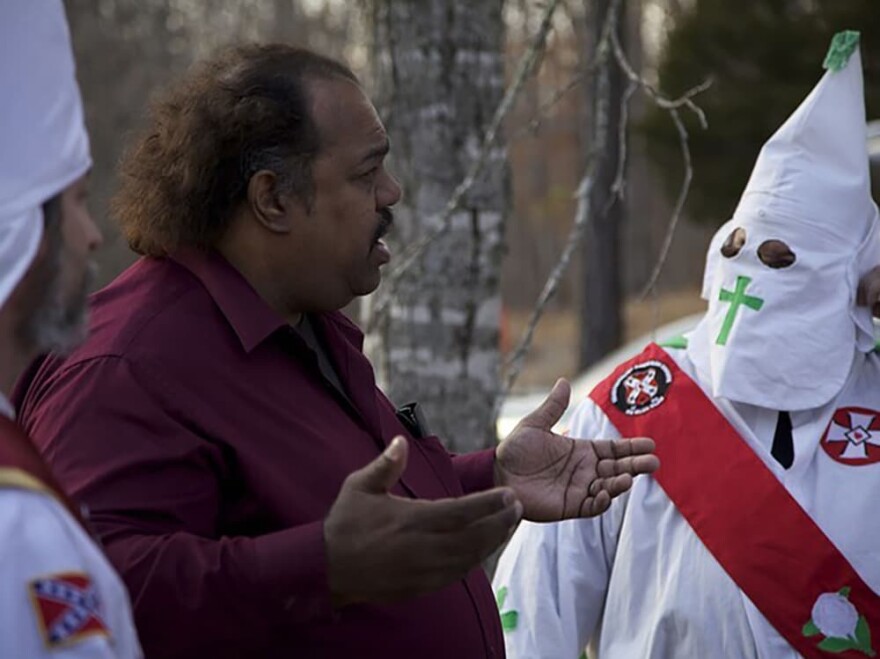
Davis’ movement is an example of how discipline and punishment can be avoided if a bridge is laid out to shift focus on understanding rather than blaming.
And it is now more than ever that we need such discourses. All in all, I consider Akhar and Mufti’s debate– even if I do not entirely agree with the debate format– to be a step in the right direction. It did a decent enough job of exposing the risks of following any ideology too far, and how ideologies can engage in dangerous mental gymnastics to justify their beliefs.
As always, think for yourself, engage in critical thinking, and do not allow anyone to do that thinking for you. And most importantly, leave some healthy room for doubt. The greatest form of evil is the evil which thinks itself right.
 anshul kandpal