
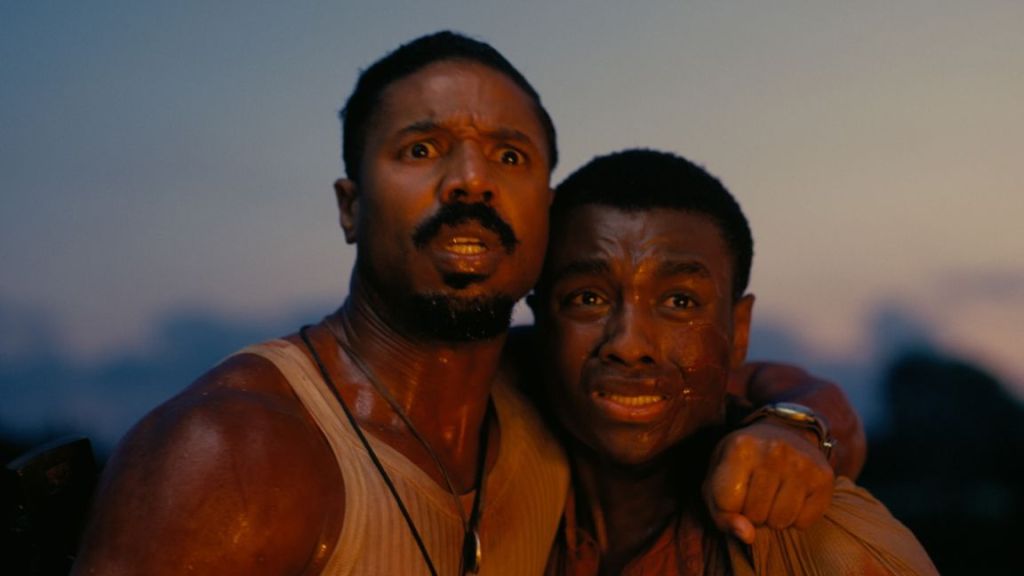
Contains minor spoilers for the movie Sinners (2025), written and directed by Ryan Coogler
“Monster myths and local religious-cum-ideological myths, even if seemingly antagonistic in nature, work in a symbiotic relationship. The development of monster myths also strengthens local religious myths”
Sinners is a prime example of an idea that I have held dearly to my heart for a long time: no other genre is capable of plunging into philosophical depths the same way horror is. Especially the philosophy of Life, Death, and the Fear of the Unknown.
Vampires have been a cultural metaphor for creatures that extract the vital essence of life from their victims, generally in the form of blood. They have existed in many cultures: as the shtriga from Albanian folklore, the chupacabra from Latin America, the jiangshi from Chinese folklore, and the penanggalan from Malaysian folklore.
The traditional vampirism in Sinners comes from European folklore, mainly the shtriga and the nosferatu. These vampires, often associated with Christian upbringings, conceptualize evil as something you can choose not to invite through your own will. It plays into the prime Christian principle of not giving into the temptation of sin.
It is paramount to consider that not just Christianity, but many ideological paradigms deploy monster and folklore myths for their belief development.
Monsters, folklore creatures, and supernatural phenomena become archetypes to contain ideas, rulesets, or cautionary tales against a phenomenon that cannot be banished or done away with by the implementation of natural law. Space for monsters and altered phenomena exists where natural laws are not absolutes, and where there is room for negotiation.
This fundamental intolerance of uncertainty gives rise to the emergence of supernatural phenomena as a subconscious method to ease anxiety by paradoxically projecting the anxiety onto a mythologizable, definable entity.
It’s interesting how folklore monsters operate as pseudo-laws for a family or cultural unit. One example would be how monsters function as cautionary tales deployed by mothers to keep their children from going out alone at night.
Monster myths and local religious-cum-ideological myths, even if seemingly antagonistic in nature, work in a symbiotic relationship. The development of monster myths also strengthens local religious myths, as can be seen in the case of the shtriga: Catholic legends emphasize the use of holy water and silver coins as weapons and amulets of protection against the shtriga. In the same way, quoting verses of the Quran is said to protect against the jinn. The development of an object of fear gives space for the development of an institution to harbor safety, and vice versa.
Yet, folklore creatures and monsters find their fertile ground in gaps in human knowledge—in those playfields of uncertainty where human logic or scientific temperament fails. In a way, something like this can only happen to myths that cannot be abolished by natural laws.
To give a very simple example: gravity, being an immutable, measured natural law, gives no space for any form of myth-making. The moment a child is born and takes its first step and falls, it knows that there is an unseen power that has the capacity to hurt it. There is no need to tell a child a story about a dangerous monster called “gravity” that can kill you if you don’t stay away from the balcony railing.
But since a dark forest may or may not invite a possibility of death, the installation of a myth becomes necessary to replace a probabilistic danger with a supernatural law. Here, the child’s fear of death—which is a hardcore natural concept—is used to breathe legitimacy into an uncertain danger.
A myth finds fertility in the space of ambiguity.
Sinners’ vampires are terrifying because they bring back that fundamental concept of free will into play and give the victims an agentic role in their own destruction
With the development of scientific temperament in the Enlightenment Age, and the spatial imperialism that humans have engaged in, the scope for spaces that inhabit the idea of the unknown has become less and less, and with it the propensity for the development of monsters.
With time, traditional monsters gave way to modern reinterpretations, each adapted to their own culture’s fears. For example, Terminator develops its antagonist trope through the development of a mechanical monster: an unfeeling, relentless force of destruction hell-bent on wiping out the very humans that created it. It embodies the anxieties and fear against the rapid rise of technology and the looming threat of artificial intelligence.
However, as happens with most iconic characters– having lost their initial cultural significance, vampires were turned into narrative tropes of “I-am-bad-guy” evil. They were reduced to being obstacles in a narrative, rather than personifications of symbolic anxieties.
And this is why Sinners’ revisit to the traditional I-need-permission-to-enter-your-house vampires is so interesting to look at.
These vampires are terrifying because they bring back that fundamental concept of free will into play and give the victims an agentic role in their own destruction. If they do lunge at you, it was your action that lead to it. It is somewhat this idea that makes playing horror games much scarier than watching horror movies. You cannot close your eyes and let the plot move forward in horror games. It is necessary that you face the very thing you fear. Escaping would require decision-making which can be irrevocable, and the cause of a bad decision is entirely your doing.
A good monster is a personification of a general anxiety of the era or place it emerges from, and does an excellent job of using that anxiety as leverage to terrify, torture, and hunt its victims
Further, this kind of traditional vampirism also plays into our primal, childlike fear of inviting strangers into your house.
The best parallel for this vampirism is “The Call of the Void”. It refers to the sudden and fleeting impulse to jump from a high-rise when standing at its precipice. Although death is certain and you are safe from, what can break this thin line of safety is your own volition.
In the conversation scenes with Remmick in Sinners, much of the tension emerges from the possibility of a character unintentionally inviting them in. We almost want to scream at them to shut up and not say anything.
From a larger cultural standpoint, Sinners’ vampires also embody the idea of manifest destiny: the colonial imperialism that so many people of color have experienced. By inviting a seemingly harmless imperialist into their world, they invite a kind of monstrosity that threatens to destroy their music, and by extension their culture and unique expression of humanity.
A movie monster that is nothing but a crazed killing machine embodies nothing more than the protagonist’s possible ingenuity at outwitting it, or the screenwriter or director’s decision to place obstacles before it to prevent it from doing so. It can surely lead to scary scenes and tense sequences in a cat-and-mouse way, but remains uninteresting beyond that.
A good monster is a personification of a general anxiety of the era or place it emerges from, and does an excellent job of using that anxiety as leverage to terrify, torture, and hunt its victims. Few of our most persistent myths and creatures have been the ones that embodied humanity’s most profound and everlasting fears—be it the loss of love, the loss of agency, the fear of the unknown, or the terror of death.
 anshul kandpal